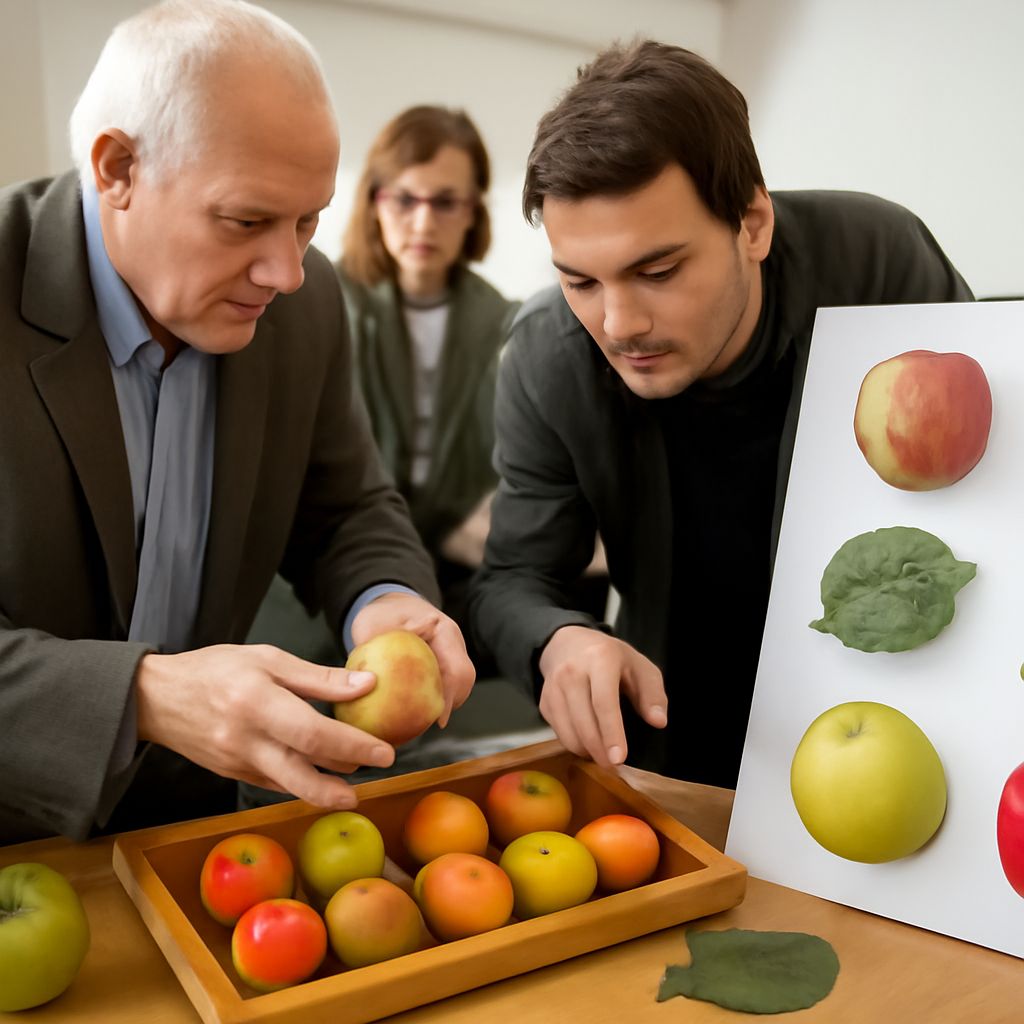
The best clue depends on the season: leaves may be available through summer, flowers in spring, and mature fruit later in the year. To recognize an apple tree among other fruit trees, compare several features rather than relying on one. If you already know you have an apple, figuring out its variety is a separate, harder question.
Start with the whole tree
Apple tree identification begins with a record of what you can see today. Photograph the whole tree, a leafy branch, and any flowers or fruit. Note the date, your region, and whether the tree is in a garden, an old orchard, or a field. A label or planting record is stronger evidence than location alone.
Both apples and pears are members of the rose family and share some features. Each can have simple leaves with toothed edges, spring blossoms, and fleshy fruit with a central seed-bearing core. A slender upright crown may suggest a pear, while an apple often has a spreading shape, but training, pruning, age, and variety affect the outline. Use the crown as a clue.
Compare leaves while they are healthy
Choose several mature leaves from different parts of the tree. Apple leaves are often oval, pointed, and somewhat dull, with fine hairs, particularly underneath. Pear leaves are often smoother and shinier. Both usually have alternate leaves and toothed margins, so a single shape or edge will rarely settle the matter. Damage can change a leaf’s appearance.
To tell an apple tree from a pear, photograph the upper and lower surfaces and include a ruler for scale. Leave a few leaves attached to the twig in another picture so their arrangement is visible. Compare these details with descriptions from a university extension service or a regional tree guide. For example, the University of Florida provides illustrated profiles of apple and pear that show the foliage and fruit together.
For pear tree identification, look for a combination of smooth foliage and other matching details, rather than assuming that every glossy leaf belongs to a pear. Inspect another leaf if it is dusty or damaged.
Look at blossoms in spring
Both trees can produce clusters of five-petaled flowers. Apple blossoms are often white with pink on the outside, while pear blossoms are commonly white. Photograph open flowers and buds, and note whether leaves are emerging.
Flower color is a clue, not a test with a sharp dividing line. Light, age, and frost can affect their appearance. In that case, keep the leaf photographs and return for fruit rather than forcing a conclusion from a bare branch.
Check the fruit as it develops
Fruit gives you another way to distinguish an apple from a pear. Apples are commonly round to somewhat elongated. Many pears narrow toward the stem and broaden toward the blossom end, but some are nearly round. Look at several mature fruits and photograph them on the branch and from the side and blossom end. Record their size and color, and note when they appear mature in your area.
A round fruit is not proof of an apple, and an unripe fruit can look quite different from a mature one. The two also share a core, so the presence of seeds in a central chamber does not separate them. Some pear flesh contains gritty stone cells, but avoid tasting unknown fruit as a means of identification. Wait for more evidence or ask a local expert if the tree remains uncertain.
What Kind of Apple Tree Do I Have After Identifying It?
Once you have established that the tree is an apple, the question “What kind of apple tree do I have?” may mean which cultivar it bears. Color alone cannot answer it: cultivars overlap, and fruit appearance can change with growing conditions. A nursery tag, planting plan, or reliable record from a previous owner may narrow the search considerably.
To work out which apple variety you have, collect several sound mature fruits and record their size, shape, skin markings, and harvest period. Photograph the blossom end, stem end, and a cut fruit as well as the whole tree. Keep notes from more than one season if possible. A local orchardist or extension educator may suggest candidates, but a visual comparison may not establish a cultivar with certainty.
If you are trying to name the apple cultivar, ask whether a local identification event or specialist can review your notes and fruit. To narrow down the apple variety, compare its traits with local records and keep an uncertain name tentative. If a tree was grown from a seed, it may not match the named cultivar of its parent fruit.
Keep a seasonal record
Apple tree identification is strongest when leaf, blossom, and fruit observations point in the same direction. For identifying a pear tree, use the same seasonal record and compare the complete set of features. Keep dates and clear photographs together so you can return to the evidence when a new clue appears.
If you want to determine your apple’s cultivar, include mature fruit photographs and any planting records in that file. To identify the apple tree among its neighbors, review the leaf undersides, blossom color, and mature fruit shape together. To recognize a pear tree, compare leaves and fruit against a regional description. If observations conflict, fruit never appears, or a cultivar name matters, send the record to your local extension office or a knowledgeable orchardist.