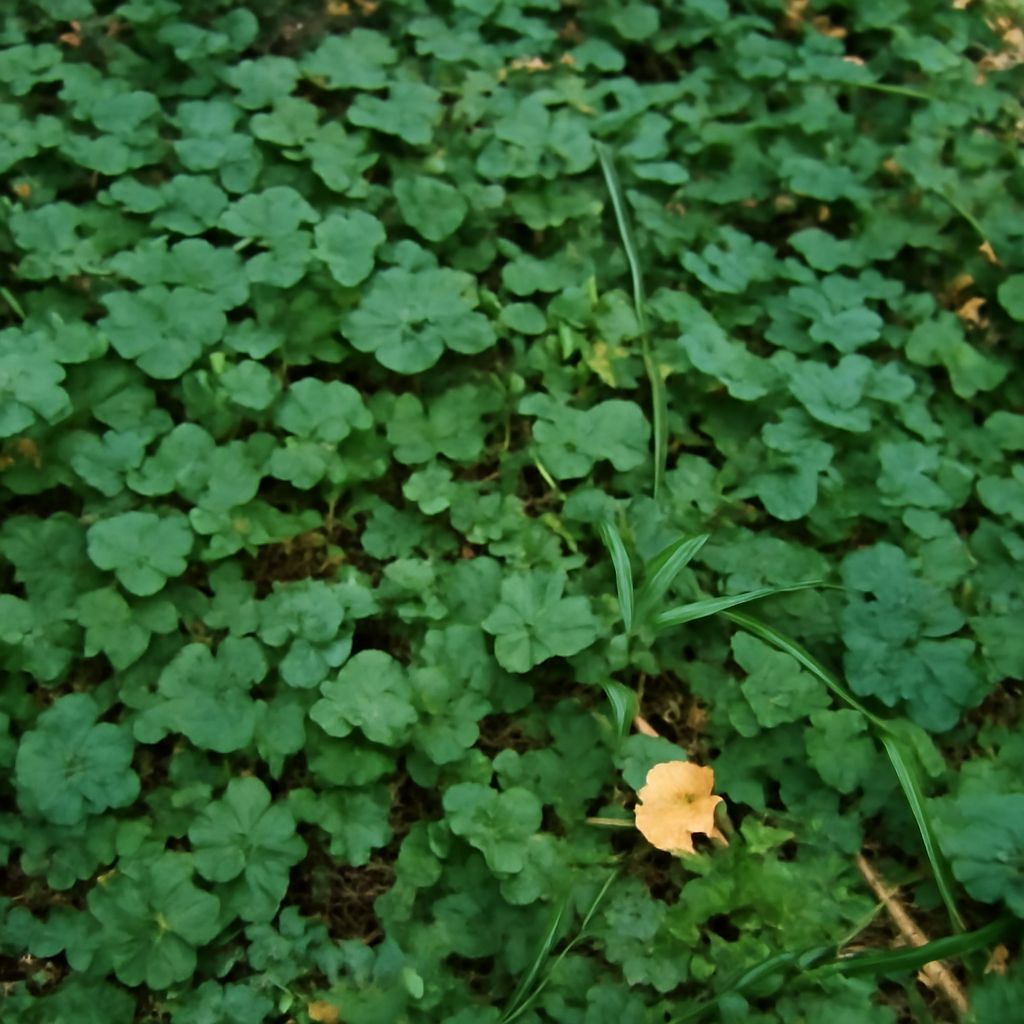
A patch of scalloped leaves has spread from the lawn into a flower bed, and small purple blooms are appearing among the stems. Before pulling, trace the runners across the soil. Ground ivy can root at many points along a stem, so removing only the visible center may leave the patch ready to return.
The plant commonly called creeping Charlie can be managed by hand in a small bed or with a broader plan in a lawn. Its blue-purple flowers help with identification, but the leaves, square stems, and rooting runners are important clues too.
Creeping Charlie flower and leaf identification
A creeping Charlie flower is small, tubular, and bluish purple, often appearing in groups where leaves meet the stem. The leaves are round to kidney-shaped with scalloped edges and grow opposite each other on square stems. Crushed foliage has a mint-like scent. The botanical name is Glechoma hederacea, also known as ground ivy.
Purple flowers on ground ivy are one clue; look at several features together. Other small plants have purple flowers or rounded leaves, and common names can overlap. University of Minnesota Extension describes the opposite leaves, square stems, and roots at the nodes. If you are unsure, photograph the leaves, creeping Charlie blossoms, and runner and ask a local extension office for identification.
The creeping Charlie plant forms a low mat. Its creeping stems, called stolons, can root where their nodes touch soil; it can also spread by seed. A runner reaching under mulch or across a bed edge may connect to several rooted sections. Mark the outside of the patch before you start so you know how much ground needs attention.
Choose a method for the site
In a flower or vegetable bed with a small patch, pulling ground ivy by hand gives you control around desirable plants. In a lawn with scattered patches, digging is possible but may leave bare spots to repair. A large lawn infestation takes more time and may call for a combination of methods and repeated work.
Map where the ground ivy is growing and where it enters from neighboring areas. If stems run beneath a fence or from an adjacent bed, include that edge in your follow-up plan. You may be able to clear your own planting while the source next door remains, so check the boundary regularly.
For creeping Charlie removal in a lawn, some gardeners choose a selective broadleaf herbicide labeled for ground ivy and their particular grass. Fall is often an effective treatment period, according to Illinois Extension. Read the product label for the site, timing, weather, repeat applications, and precautions; local rules and available products vary.
A lawn product can injure flowers, vegetables, shrubs, and trees. Do not use it in a garden bed unless the label specifically permits that use, and prevent drift onto nearby plants. If you prefer not to apply an herbicide, plan on repeated pulling and lawn repair. Avoid borax or household mixtures: Illinois Extension warns that results are inconsistent and soil damage can persist.
Pull and dig a small patch
Work when the soil is moist enough to loosen roots without smearing into mud. Starting at an outer edge, lift a runner gently and follow it to each rooted node. Use a hand fork to loosen roots and lift the connected sections. Take care around bulbs and shallow roots of plants you want to keep.
Put the removed stems and roots in a bag or container as you work. A fragment left on damp soil can root again. Check the exposed ground for small pieces, then clear tools and footwear before moving to another bed. Dispose of the material according to local yard-waste guidance rather than dropping it where it can grow.
Removing creeping Charlie from a mixed bed is rarely a single visit. Return while the remaining shoots are small, loosen their roots, and lift them before they reconnect into a mat. Mark the cleared edge with a small stake if it is hard to distinguish later.
Restore the space it occupied
In turf, bare patches left by the creeping Charlie plant give it room to return. After control, repair thin lawn at the appropriate season with grass suited to the site’s light and soil. Follow any herbicide label’s waiting period before seeding. A lawn that receives too little light for grass may be better managed as a separate shaded planting area.
In a garden bed, leave room around the crowns of desirable plants and watch for new runners at the edge. The purple blooms of creeping Charlie may appear again in spring, but leaves and runners are often visible before flowering. Remove new growth promptly rather than waiting for it to bloom.
Check again and act on regrowth
Inspect the cleared area every few weeks during active growth and after neighboring growth reaches the boundary. Look under plant leaves and along fences for the scalloped foliage of ground ivy. Lift new stems with their rooted nodes, bag the material, and note where it appeared.
After a lawn treatment, follow the label’s interval before assessing whether another application is allowed or needed. If ground ivy returns repeatedly from one edge, focus your next removal of creeping Charlie on that entry point as well as the visible patch. Continue checking into the next growing season; a small new shoot is easier to remove than a mat woven through the bed.


